Golden Hour Wedding Photos: How to Plan Your Timeline Around Sunset
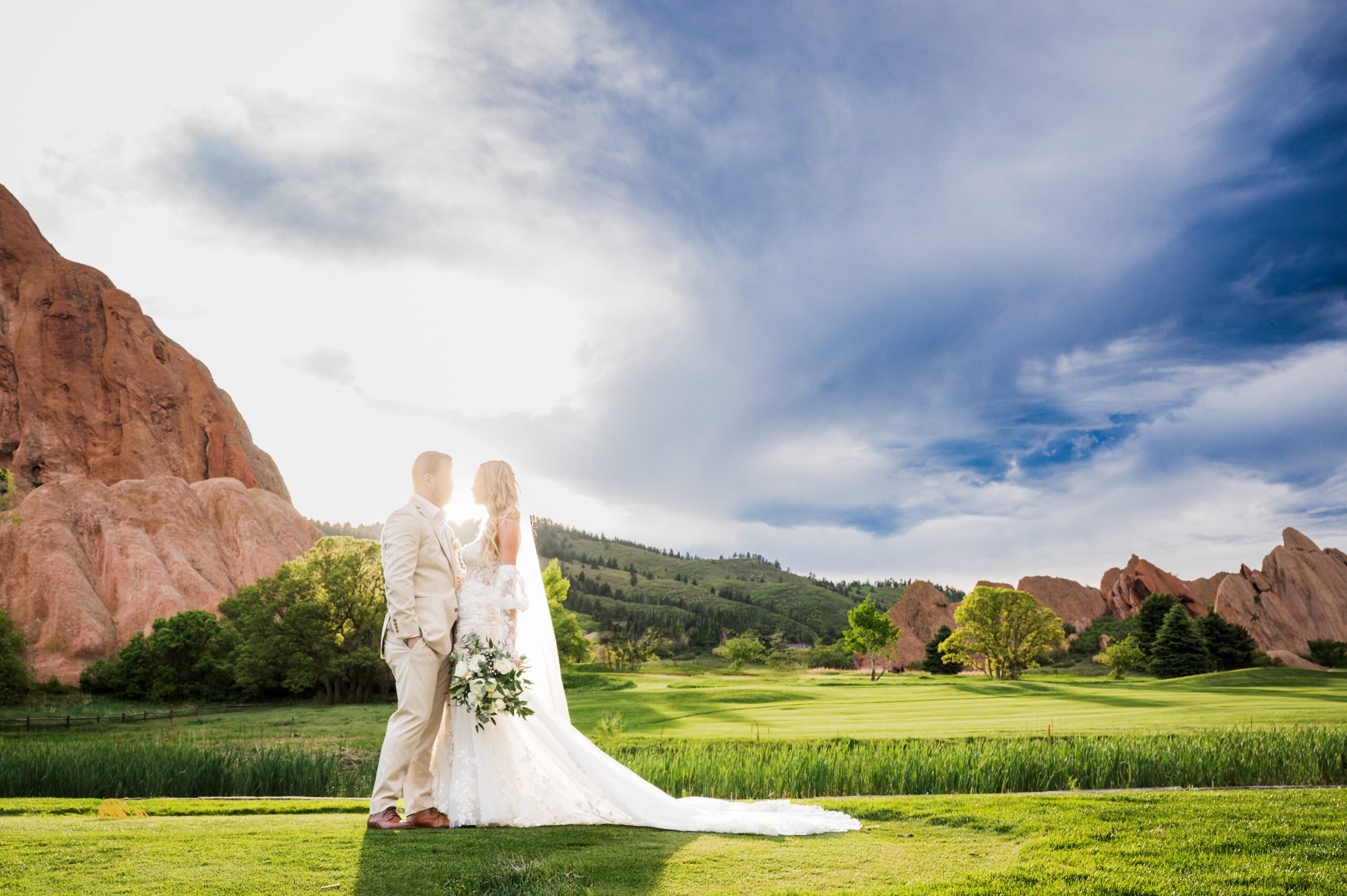


Almost every couple asks for golden hour photos. Almost nobody plans the timeline that makes them possible. The light only lasts about half an hour, it moves every single week of the year, and it does not wait for your toasts to finish.

Here is how to find your sunset, and what changes depending on whether you are getting married in the mountains, in the city, on the water, in January or in July.
Look up one number before you set your ceremony time
Search the sunset time for your exact date at your exact venue. Golden hour is roughly the thirty to forty five minutes before it. You want fifteen to twenty of those minutes, just the two of you, away from everyone.
That number moves more than people expect. In Denver, December sunsets land between 4:35 and 4:45 in the afternoon. Sunsets at 8:00 or later only happen from roughly early May through the middle of August. Same venue, same plan, more than three hours apart.
Mountain venues: the sun leaves before sunset
This is the one that surprises couples. Official sunset is when the sun drops below the horizon. Behind a ridge, your light is gone thirty to sixty minutes earlier than that.

Ask your venue what time the sun goes behind the ridge in your month. That is your real number, not the one on your phone. Then build backward from it.

City venues: the buildings take the direct light
Downtown you lose the direct sun earlier, but you gain two things nobody else gets. Light bouncing off glass, which is soft and flattering from every direction, and a skyline that turns on right as the sky goes pink.

The move is to find one west facing open space within a few minutes of your venue. A rooftop, the top floor of a parking structure, a park across the street, a bridge. One spot is all you need.

Beach and water: know which way your coast faces
On a west facing coast the sun sets over the water and you get the postcard. On an east facing coast the sun sets behind you instead, which gives you soft backlit sand, a pink sky over the ocean and no squinting. Both are beautiful. You just want to know which one you have before you plan around it.

One more beach note. Wind picks up near sunset on most coastlines, so if your hair and veil have a strong opinion about that, go a little earlier in golden hour rather than later.
Winter weddings: golden hour comes before your ceremony
With a 4:40 sunset, a five o’clock ceremony means every portrait happens in the dark. That is the whole math of a winter wedding.

Two ways to solve it. Do a first look in the early afternoon and take your portraits before the ceremony, or move the ceremony itself to two or two thirty. Winter light is also the softest light of the year, low and warm and golden for much longer than it is in July, so you are not settling for anything.

Summer weddings: golden hour lands in the middle of dinner
A five o’clock ceremony in July puts golden hour somewhere around salads and the first toast. That is fine. You just have to decide in advance that you are leaving for fifteen minutes.
Couples who plan that step out take it. Couples who leave it open do not, because by then you are in it and nobody wants to be the one to interrupt. Put it on the timeline with a time next to it.

What to tell your planner and your DJ
- The time you are stepping out, on the printed timeline, not as a maybe
- That it is fifteen to twenty minutes and you are coming right back
- That it moves if the sky does something good, so stay flexible by ten minutes either way
- That nothing with a speech attached should be scheduled in that window

Questions we get asked the most
What time is golden hour on my wedding day?
Roughly the thirty to forty five minutes before sunset at your venue. Look up the sunset time for your exact date, then count backward. In the mountains, subtract another thirty to sixty minutes for the ridge.
How long do we need for sunset photos?
Fifteen to twenty minutes is plenty. These are the easiest photos of the whole day because the hard part is already over.
What if it is cloudy?
Clouds often make it better. A flat grey sky gives you soft even light all afternoon, and a broken sky at sunset is the one that turns pink and orange. The only genuinely hard sky is a bright cloudless noon.
Do we need a first look to get golden hour photos?
No. A first look gives you more portrait time overall and a calmer afternoon, but golden hour happens whether or not you did one. It just changes what else has to fit around it.
Can you still take photos after the sun goes down?
Yes. The twenty minutes after sunset, when the sky goes deep blue and the venue lights come on, is its own kind of beautiful. Worth stepping out twice if you have it in you.
When you are ready
We build this into every timeline we help plan, at every kind of venue. If you want more on the rest of it, here is how to build a wedding photo timeline that actually works, more on wedding day sunset photos, and our tips for mountain, winter and church weddings.

Planning a wedding in Colorado or somewhere further out? Get in touch or see our collections.
October 29, 2026
Be the first to comment